
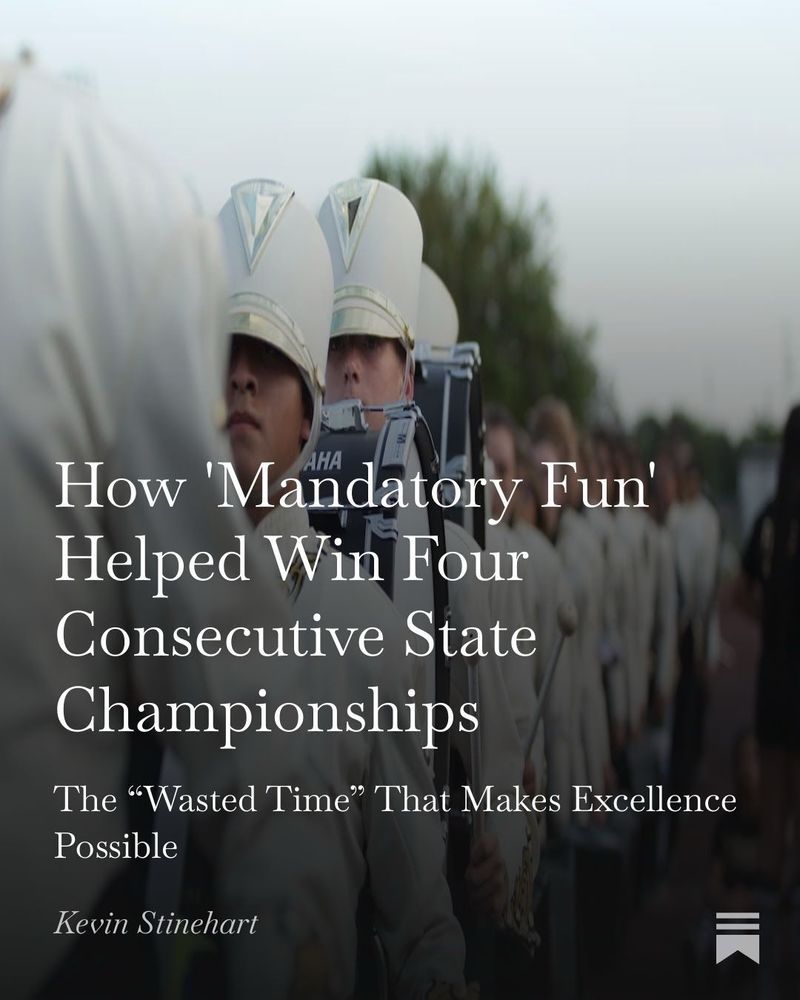
“Work hard. Play hard.” is the kind of phrase that usually lives on a t-shirt you win at a charity 5K.
But this week I interviewed Chaz Paxton, the band director who has led D.W. Daniel High School to four consecutive state championships (and running), and he described creating time for free play like it’s not a break from excellence but one of the engines of it. In his words, play works because it “creates an environment where students can be themselves and connect in meaningful ways.”
That line stuck with me, because it names the thing school systems keep trying to skip.
If you want a strong band, a strong team, a strong school, a strong classroom, even a strong family, you have to let humans be themselves. You have to protect real relational connection, not the fake “we’re a family” poster version, but the kind built through shared experience and low-stakes joy.
And the most revealing place to see whether a system actually believes that is right after lunch.
After Lunch Is Where Systems Tell the Truth
The morning juice is gone. The air is heavier. People are slower, a little irritable, a little checked out. If you lead kids for a living, you can feel it in your bones: this is the hinge in the day. The place where momentum either returns…or the whole afternoon becomes one long, slow negotiation with reality.
In classrooms, this is where we start paying. Not always with a meltdown. Sometimes with a thousand tiny drags: transitions that crawl, low-grade conflict, a steady drip of redirections, the teacher repeating themselves like a glitchy recording, students “forgetting” expectations they have known since August. Everybody is technically doing school, but the cost of doing school goes way up.
Now put that same hinge moment inside a twelve-hour band camp day in a program chasing repeated excellence at a state-championship level. The adult instinct is obvious: tighten up. Push through. No wasted minutes. Our program is the absolute best, so we better work like it.
But at D.W. Daniel High School, right at that hinge, the band does something that makes “all business” adults squint like they just found a typo in the handbook.
They stop for free play.
Student-led. Scheduled. Protected. Not as a reward. Not as a treat. Not as a “we earned this” moment.
The students named it “Mandatory Fun,” which sounds like a corporate retreat and a teenager joke at the same time. (“Yes, yes, we must have fun now. Tragic.”) But the name is also a clue: this is not accidental. It is built into the culture.
Here is the part that makes it impossible to dismiss as soft: the director, Chaz Paxton, has led the program to four consecutive state championships. This is not a “cute vibes” program where kids get to explore the arts through music. This is a serious, high-expectation program that does the work.
So I interviewed Chaz because I wanted to know what he sees, what changes, and what he says to the adult who hears “play” and immediately thinks “wasted time.”
And honestly, I wanted to know what it means that one of the most successful programs in the region is doing something many schools have trained themselves to fear. Play.
“Mandatory Fun” In Plain Language
Chaz explained it simply:
“Mandatory Fun happens during band camp….where the kids play a game…led by a portion of our (student) leadership team.”
That is it. High schoolers playing Duck Duck Goose, Hide and Go Seek, Tag, whatever they want.
That student-led detail is not a cute footnote. It is the whole point. In schools, a lot of what we call “fun” is adult-owned joy. Adults pick it, adults manage it, adults narrate it, adults sanitize it, and then we quietly hope it improves behavior afterward. It becomes another compliance moment wearing a party hat.
This is different. The adults protect the time, but students own the experience. Student leaders run it. Students named it. They have agency inside it.
That is a Tier 0 move. If you have read my work on Tier 0, you know what I mean: the work beneath the work. The conditions that determine whether humans can do hard things without falling apart. Belonging, autonomy, connection, psychological safety, and a nervous system that is not clenched all day.
Most of what we call “Tier 3 problems” (achievement, behavior, motivation, focus) are often downstream of Tier 0 conditions. We keep trying to fix the end of the chain while straining the beginning of the chain, then acting surprised when the chain snaps.
Tier 0 is not a nice-to-have. It is the foundation that makes everything else possible.
The Origin Story (And Why it Matters)
Chaz told me he started doing an after-lunch break early in his career as a brain reset and something enjoyable in the middle of long days. At first, it was not even play. It was videos.
“When it first started, it was 15-20 minutes of a drum corps show on video or some kind of motivational video.”
When he got to D.W. Daniel, the students wanted to do a game after lunch led by leadership. He thinks they were already doing something like this before he arrived, and it evolved.